What Is Disc Golf?
Disc golf is an outdoor sport played exactly like traditional golf. Instead of a ball and clubs, you throw a flying disc. The objective is simple: complete each hole on the course in as few throws as possible. The player with the lowest total score at the end of the round wins.
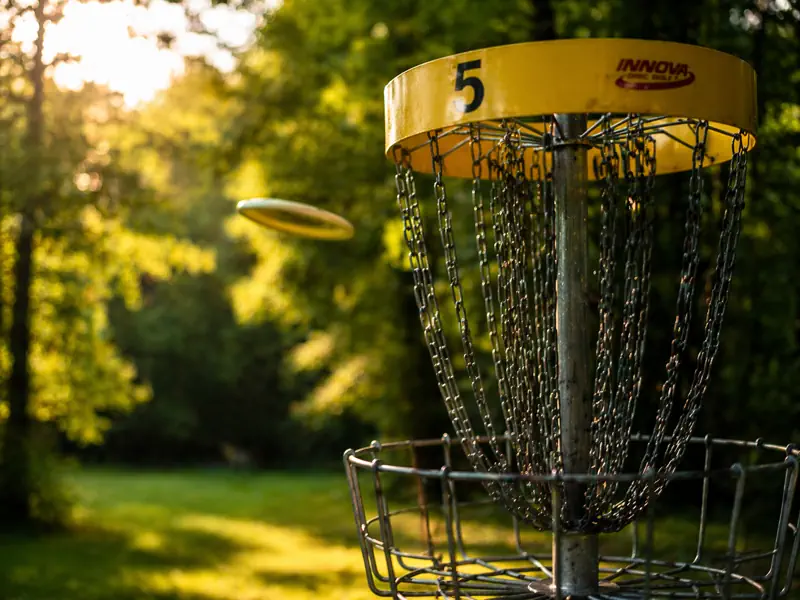
The game is played on a course made up of 9 or 18 holes. Each hole has a designated tee pad where you start and a target, which is typically a metal pole basket with hanging chains, where the hole ends. You throw from the tee, work the disc down the fairway, and keep throwing until the disc lands in the basket.
Disc golf is one of the fastest-growing sports in the world. Participation in the United States tripled between 2019 and 2023. The vast majority of courses are set in public parks and are completely free to play.
How the Game Works
A disc golf course is laid out across natural terrain. You play through woods, across open fields, and around hills and water. Each hole is a unique design with its own challenges: tight wooded fairways, open distance holes, doglegs that require you to shape your throw around obstacles.
Every hole has a par, which is the expected number of throws it should take a skilled player to complete it. Most disc golf holes are par 3, though par 4 and par 5 holes exist on longer courses. A regulation 18-hole round typically has a total par between 54 and 63.
After each throw, you play from wherever your disc lands. That spot is called your lie. You must place your non-throwing foot behind the lie when throwing. This continues until the disc is in the basket, at which point you record your score for the hole and move on to the next tee.
Play on each hole is typically conducted in a group of two to five players. The player who scored lowest on the previous hole throws first on the next tee. This is called having the honor. After teeing off, the player whose disc is farthest from the basket throws next.
Ready Golf: In casual recreational play, most players use "ready golf," which means you throw when it's safe to do so without waiting strictly for honor order. This keeps the pace moving and is the standard approach for beginners playing their first rounds.

Scoring in Disc Golf
Disc golf uses the same scoring terminology as traditional golf. Every throw counts as one stroke. Your score on each hole is the number of throws it took to get the disc in the basket. Your final round score is the total of all your hole scores across the entire course.
Scores are measured relative to par. If a hole is par 3 and you complete it in 3 throws, you made par. If you complete it in 2 throws, that is one under par, which is called a birdie. The further under par your total round score is, the better.
| Score Name | Throws Relative to Par | Example (Par 3 Hole) |
|---|---|---|
| Condor | 4 under par | Ace on a par 4 (rare) |
| Albatross | 3 under par | 1 throw on a par 4 |
| Eagle | 2 under par | 1 throw on a par 3 |
| Birdie | 1 under par | 2 throws on a par 3 |
| Par | Even | 3 throws on a par 3 |
| Bogey | 1 over par | 4 throws on a par 3 |
| Double Bogey | 2 over par | 5 throws on a par 3 |
In competitive play, the PDGA also uses a total strokes format where scores are listed as a number relative to par. For example, −8 (eight under par) or +4 (four over par). Negative numbers are better. The lowest total wins.
The Ace
An ace is throwing the disc directly into the basket from the tee pad on a single throw. It is disc golf's equivalent of a hole-in-one. Aces are celebrated events on any disc golf course. It's common tradition for a player who aces a hole to buy drinks for their group afterward. Some courses maintain ace boards listing every recorded ace on that course.
What Equipment Do You Need?
The barrier to entry in disc golf is extremely low. At minimum, you need one disc and a pair of comfortable shoes. A beginner disc costs between $10 and $15 at most sporting goods stores, and most courses are free to play.
Discs
Disc golf discs come in four main categories: distance drivers, fairway drivers, mid-range discs, and putters. Each flies differently and serves a different purpose on the course.
For a complete beginner, start with a mid-range disc. Mid-ranges are slower, more controllable, and far more forgiving than drivers. The Discraft Buzzz and Innova Roc3 are the two most recommended beginner mid-ranges in the sport.
Avoid drivers as a beginner. Distance drivers require significant arm speed and proper technique to fly as designed. In the hands of a new player they almost always turn over and crash. You will not get more distance. You will actually get less distance and far less control. Start with a mid-range and work up from there.
Bags
Once you've got a few discs, a disc golf bag keeps them organized on the course. Basic starter bags run between $20 and $40 and hold 8 to 10 discs. For your first rounds, a simple bag or even a small backpack works fine.
Other Gear
Beyond discs and a bag, most players carry a mini marker disc to mark their lie. You'll also want comfortable walking shoes with decent grip, especially on wet or hilly courses.
Finding a Disc Golf Course
There are more than 14,000 disc golf courses across the United States, which is actually more than the number of traditional golf courses in the country. The overwhelming majority are free to play, set in public parks maintained by local governments and volunteer groups.
The two best tools for finding courses near you are the PDGA Course Directory at pdga.com and the UDisc app, free on iOS and Android. When starting out, look for courses labeled beginner-friendly or recreational in UDisc. These tend to have shorter holes, more open fairways, and forgiving layouts.