How to Throw a Disc Golf Disc Farther
The fastest way to throw farther: Throw smoother, not harder. Use your hips first, keep the disc close to your chest through the pull through, snap your wrist late at release, release flat, and choose a disc that matches your current arm speed. Most players gain more distance by dropping to 80 percent effort with cleaner mechanics than by throwing harder with worse form.
For a complete foundation on throwing mechanics, see the disc golf throwing technique guide. For help choosing the right disc for your arm speed, see disc types explained. This page focuses specifically on what produces distance and how to develop it systematically.
What Actually Generates Distance in Disc Golf
Most beginners approach distance the wrong way. They assume throwing harder produces more distance, so they muscle up, add tension to their arm, and heave the disc as hard as they can. The disc goes sideways, crashes into the ground, or turns over immediately. They try again with the same result.
Distance in disc golf comes from a combination of disc speed, spin, nose angle, release angle, and clean mechanics. For most developing players, improving spin generation and release quality produces more distance faster than simply trying to throw harder. A disc that leaves your hand with high rotational velocity will fly farther than a disc thrown with more linear force but less spin, because spin is what stabilizes the disc and allows it to glide through its full intended flight.
This is why professional disc golfers who weigh 150 pounds can throw distance drivers 450 feet, while physically powerful beginners struggle to get a disc to fly correctly at 200 feet. The professionals have developed a throwing motion that generates enormous spin through precise mechanics. The beginners are throwing hard without generating adequate spin or maintaining the release angles that allow the disc to fly efficiently.
BWBDA field note: Most newer players we see gain distance fastest by dropping down to a mid-range or fairway driver, throwing at 70 to 80 percent effort, and focusing on a flat release before adding run-up speed. The distance gains from cleaner mechanics at lower effort almost always exceed what players can produce by throwing harder with degraded form.
Spin vs. Power
A flying disc generates lift and stability through gyroscopic spin. The faster the disc rotates on its axis, the more stable and predictable its flight becomes. A disc with high spin holds its flight path longer, resists wind better, and carries farther before fading than the same disc thrown with low spin at the same speed.
Spin is heavily influenced by late wrist action, grip, and clean release mechanics at the moment of release. The speed and precision of that final wrist motion determines how much spin the disc has when it leaves your hand. A smooth throw with a sharp late wrist action will generate more spin than a tense, muscled throw with a weak or early wrist release, even if the linear velocity of the arm is higher on the harder throw.
How to Generate More Spin
Generating more spin requires a relaxed arm and a crisp wrist snap at the release point. Tension in your hand, wrist, or forearm kills spin. Before throwing, consciously relax your grip slightly and keep your arm loose through the motion until the very last moment, when the wrist snap fires.
Practice this by throwing at very low power with maximum wrist snap focus. Throw at 40 to 50 percent of your maximum effort and think only about the snap. You will likely find that these lower-power throws with focused snap travel farther and more accurately than your harder throws. That experience is the proof of concept for everything in this guide.
The Key Mechanics of a Distance Throw
Distance comes from a chain of mechanical events that must happen in the correct sequence. If any link in the chain breaks down, both distance and accuracy suffer. Here are the components in the order they should occur, along with related guidance from the complete throwing technique page.
Hip Rotation First
The power in a disc golf throw originates in the hips and core. At the start of the forward motion, your hips should rotate toward the target before your shoulders, and your shoulders before your arm. This sequential unwinding is called the kinetic chain, and it is what transfers rotational energy from your largest muscle groups into the disc. Players who throw with arm-only motion bypass the hips entirely and lose the largest source of power available to them.
The Reach Back
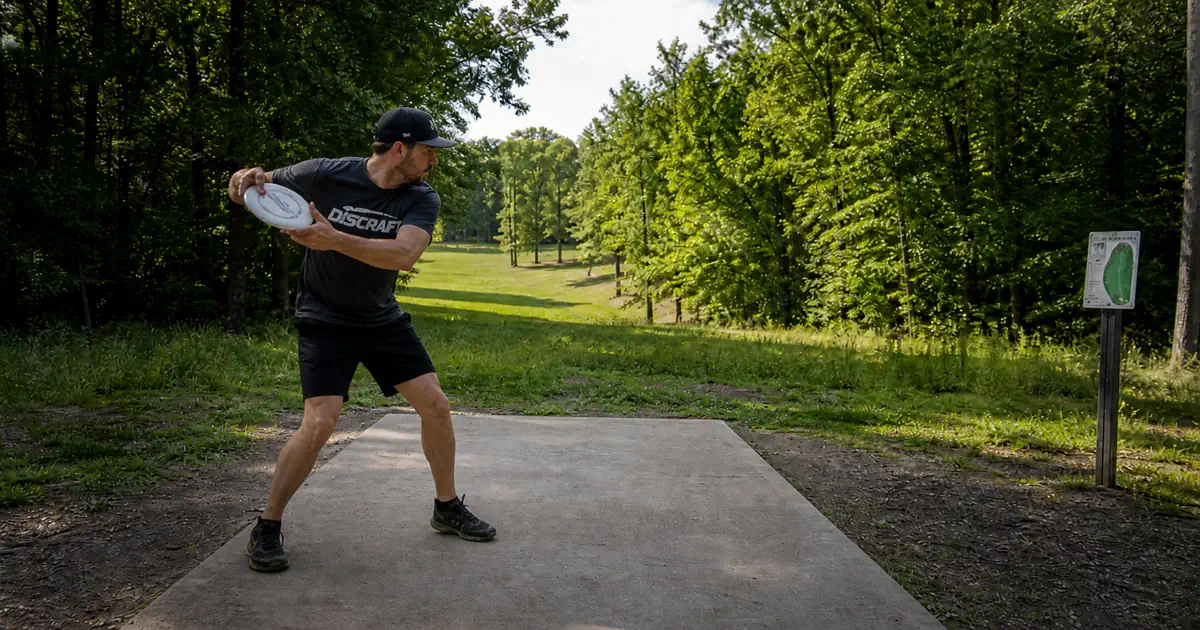
A full reach back at chest height gives the disc maximum distance to accelerate before release. Keep the disc at chest height through the reach back. Do not let it drop to your hip, which changes the release angle and wastes energy. Do not bring it above shoulder level, which disrupts the forward motion. The reach back is a controlled coil where your weight shifts to your back foot and your hips turn away from the target.
The Power Pocket and Pull Through
The pull through is where the disc accelerates from reach back to release. Keep the disc as close to your chest as possible through this phase. This position, often called the power pocket, is where players generate the most disc speed. A disc that swings wide away from the body during the pull through loses speed and accuracy.
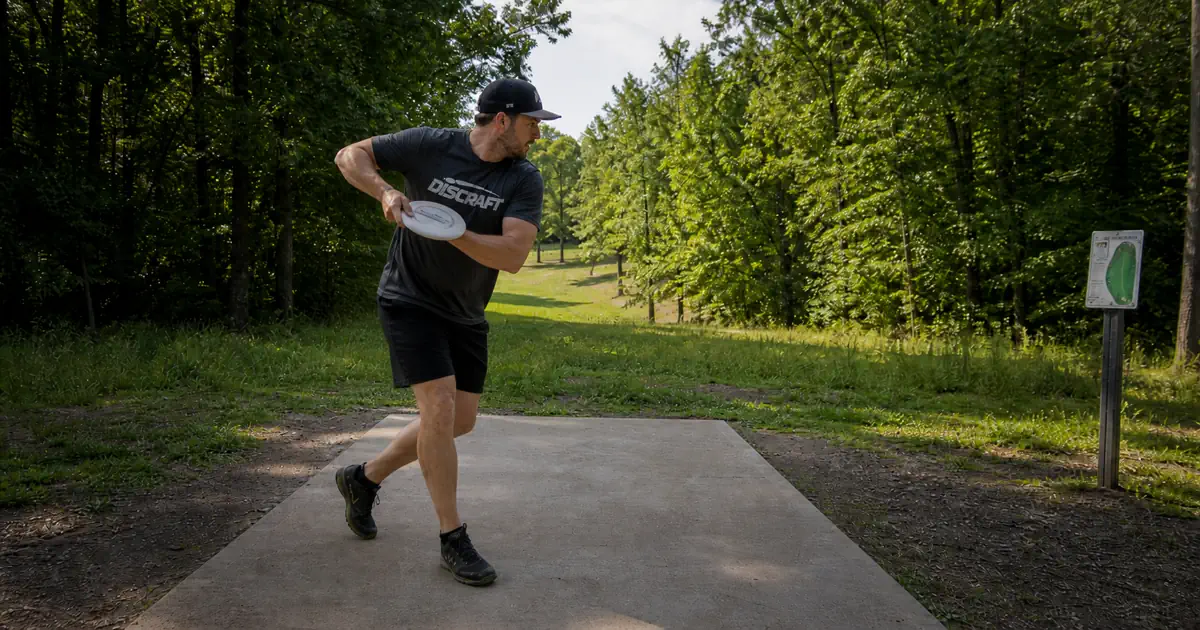
Your elbow should lead the pull through, with the forearm and disc trailing slightly behind. This lag is where the wrist snap loads. A player who fires their wrist too early, before the elbow has fully driven through, loses the snap and the spin that goes with it.
Release Point and Flat Angle
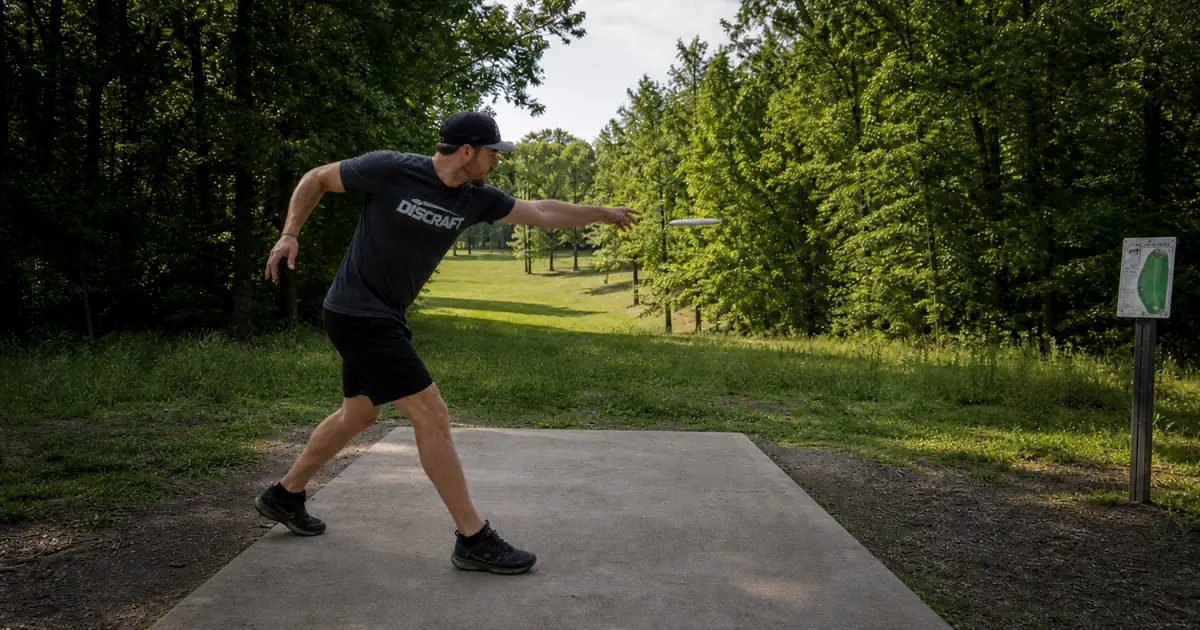
The release point should be directly in front of your chest, with the disc pointing at your target on a flat plane. A release that happens too early sends the disc right. A release that happens too late sends it left. Most players have a consistent release point error they can identify and correct once they are aware of it.
The X-Step
Advanced players use a footwork approach called the X-step to add body momentum to their throw. The X-step involves a specific foot pattern on the run-up that creates forward momentum transferring into the throw.
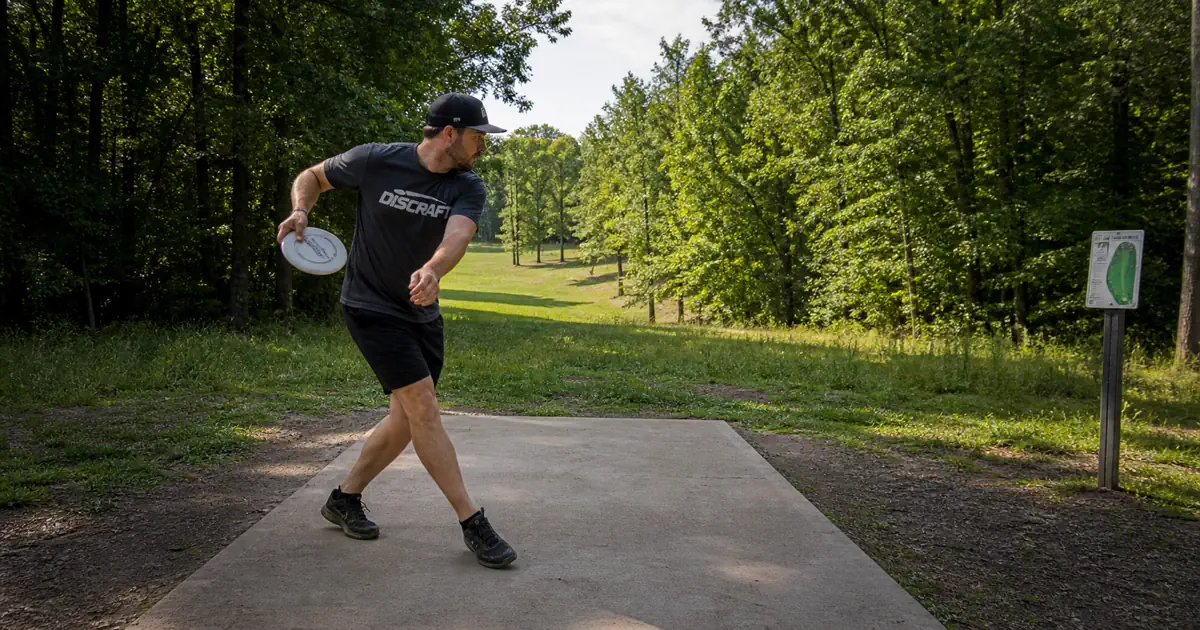
Learn the X-step only after your standing throw mechanics are consistent. Adding run-up footwork before your standing throw is reliable creates more variables and usually hurts distance rather than helping it. Once your standing throw is solid, the X-step can add 20 to 40 feet of distance for most players.
Follow Through
After releasing the disc, your throwing arm should continue forward and wrap around toward your opposite shoulder. A complete follow through indicates you committed to the throw and did not decelerate before release. Players who stop their arm at release almost always produce short, weak throws.
Disc Selection and Distance
Choosing the right disc for your arm speed is one of the most misunderstood aspects of adding distance. Most beginners reach for distance drivers because they assume high-speed discs go farther. For players without sufficient arm speed, the opposite is true.
A distance driver with a speed rating of 12 or higher requires significant arm speed to fly correctly. Thrown at lower speeds it turns over and crashes. A mid-range or fairway driver thrown correctly at your arm speed will produce more distance than a distance driver thrown incorrectly.
Disc Type Comparison for Distance
| Disc Type | Best For | Beginner Friendly | Typical Distance | Common Mistake |
|---|---|---|---|---|
| Mid-Range | Learning form, tight holes, approach | Yes | 150 to 280 feet | Underestimating how far it can go with good form |
| Fairway Driver | Tee shots, controlled distance | Mostly yes | 200 to 350 feet | Throwing too hard before mechanics are ready |
| Distance Driver | Max distance with developed arm speed | No | 250 to 450+ feet | Using one before arm speed is sufficient — disc turns over and crashes |
When You Are Ready for a Driver
When your fairway driver is flying straight and complete and you can feel the difference between a good throw and a bad one, try a controllable driver such as an Innova Beast, Latitude 64 Diamond, or Discraft Heat. These are more forgiving than high-speed distance drivers and give developing players a better chance of experiencing what a correctly flown driver feels like.
If the driver turns over and crashes consistently, you are not ready yet. Go back to the fairway driver for another month of focused field work. For full details on how each disc type flies see the disc types explained page.
Understable discs for distance: Understable discs with a high negative turn rating require less arm speed to fly through a full S-curve and cover maximum ground. The Innova Leopard3 is one of the most recommended understable fairway drivers for players working on distance. It flies a long gliding S-curve at moderate arm speeds and shows you what a properly thrown driver flight looks and feels like.
Common Distance Mistakes
Throwing Too Hard
Maximum effort almost always produces less distance than 80 percent effort with good mechanics. Tension kills the wrist snap that generates spin. Relax and throw smooth. Distance comes from the snap, not the effort.
Using the Wrong Disc
Throwing a distance driver before your arm speed can make it fly correctly. The disc turns over and crashes. A mid-range or fairway driver thrown with proper mechanics goes farther than a distance driver thrown incorrectly.
Arm-Only Throwing
Not engaging the hips and core in the throwing motion. The arm alone cannot generate the rotational energy that produces disc speed. Drive your hips toward the target first and let the arm follow that rotation.
Releasing Off-Plane
Releasing the disc on an angle rather than flat wastes distance. A disc released on anhyzer turns right and loses glide. A disc released on hyzer fades immediately. Practice releasing flat for maximum straight-line distance.
Disc Swinging Wide
Letting the disc swing out away from the body during the pull through rather than pulling tight across the chest. A wide pull through loses speed and accuracy. Keep the disc in the power pocket through the entire forward motion.
Distance Progression Plan
Master the Mid-Range at 70 Percent
Throw a mid-range disc at 70 percent effort with full focus on hip rotation, tight pull through, and wrist snap at release. Do 50 to 100 field throws per session. Consistency and distance both improve faster than throwing hard.
Add an Understable Fairway Driver
Once your mid-range flies straight and controlled, add an understable fairway driver. Apply the same mechanics at 70 to 80 percent effort. The Innova Leopard3 is one of the most recommended options for this stage.
Learn the X-Step
Add the run-up footwork to your fairway driver throws. Learn it slowly in field work only until it is automatic. Only add it to course play once it feels natural and does not disrupt your throw.
Try a Controllable Driver
Once your fairway driver is flying correctly and your form is consistent, try a beginner-friendly driver such as an Innova Beast, Latitude 64 Diamond, or Discraft Heat. If it turns over consistently, return to the fairway driver for another month.
Grab a mid-range, go to a field, and throw 50 reps at 70 percent effort focusing only on hip rotation and wrist snap. Do that three times a week for a month before worrying about anything else.
Field work builds distance faster than rounds. The course has too many variables. The field is where mechanics become automatic.
Reviewed by BWBDA: This guide was created by Black Wolf Bay Disc Golf Association to help newer players build distance with safer, cleaner form before moving into high-speed drivers. For official rules on throwing technique in sanctioned play, see the PDGA Official Rules.